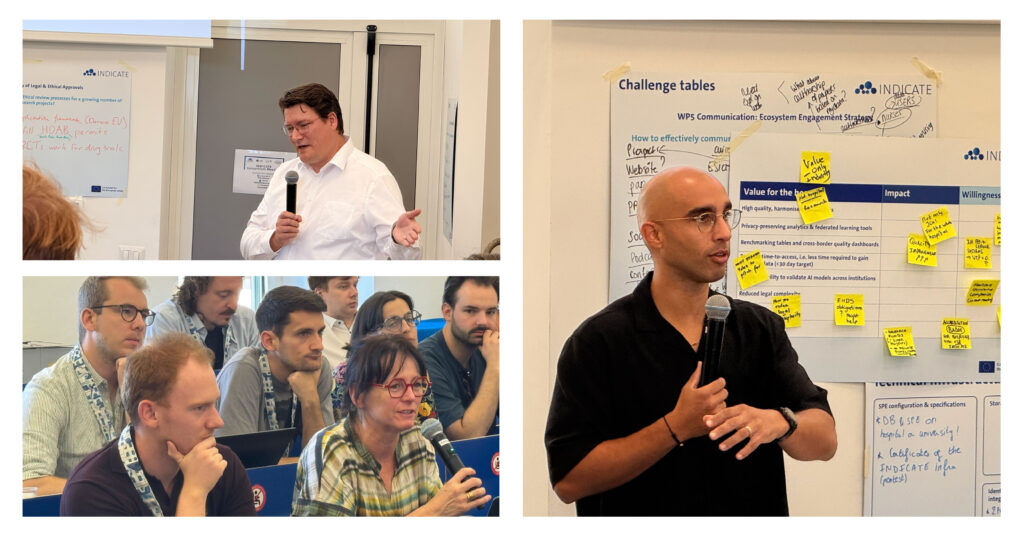
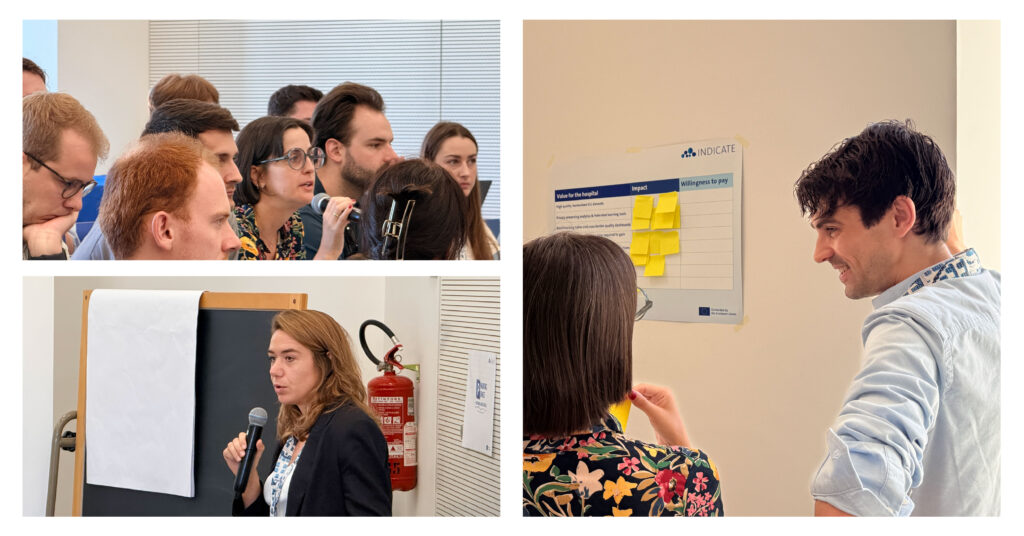
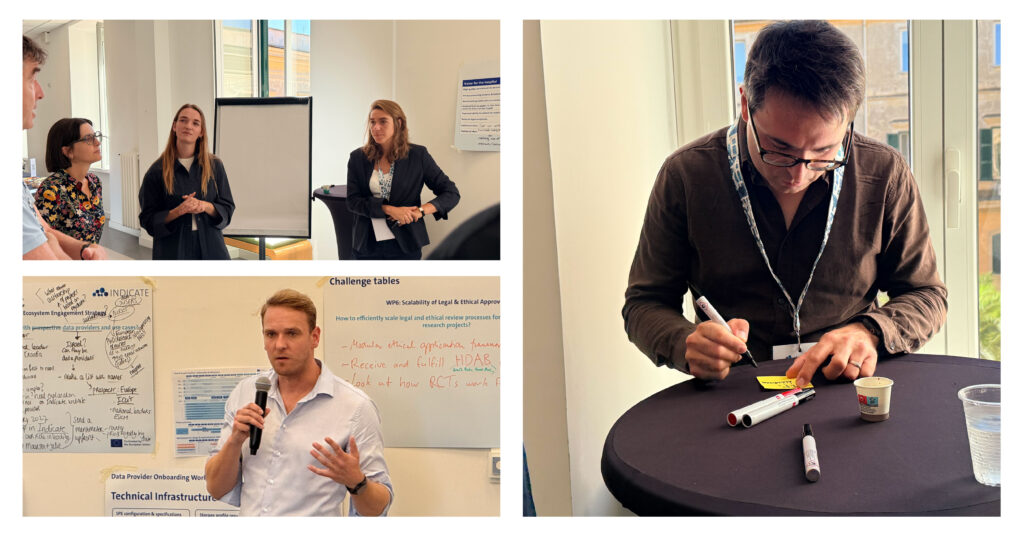
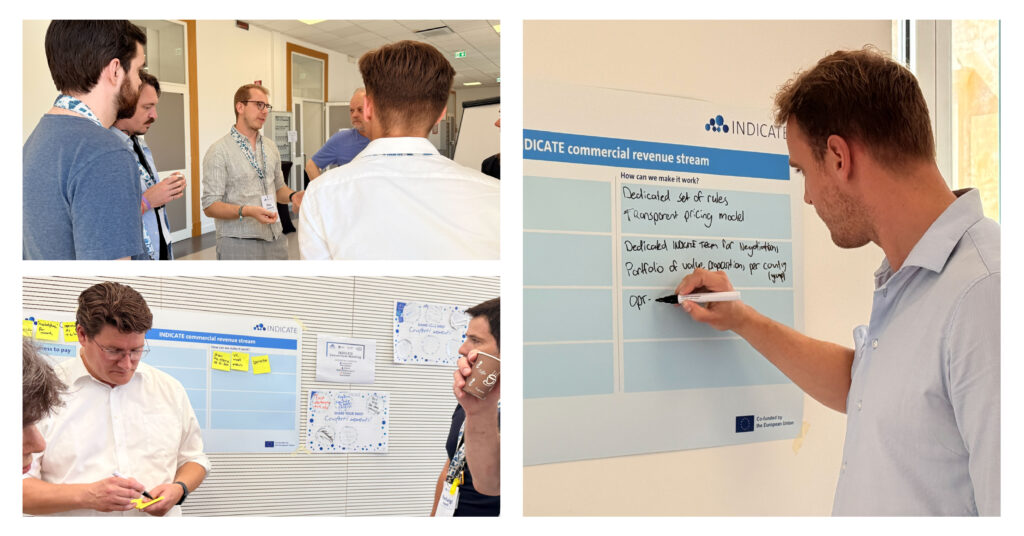
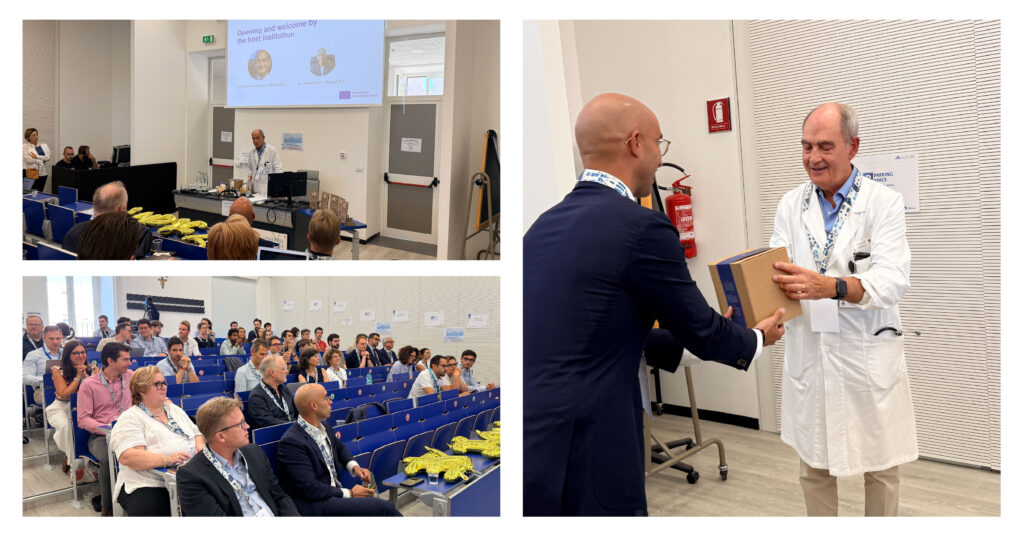
The INDICATE Consortium Meeting, hosted by Fondazione Policlinico Universitario Agostino Gemelli IRCCS in Rome taking place from Monday September 14 till Wednesday September 16, marked an important milestone in the journey from developing the INDICATE infrastructure concept to putting it into practice and building a sustainable future beyond the project.
Over three days, consortium partners came together to take stock of progress and lessons learned, align on the implementation pathway, and translate the project’s ambitions into concrete actions. The meeting equipped partners to act as INDICATE ambassadors, with a shared understanding of the end-to-end journey for data providers, data users and research projects, as well as the actions needed to support the successful implementation and transition of the infrastructure.
The programme followed a clear three-day path:
Day 1 – Understand The first day focused on taking stock of progress, reflecting on lessons learned and building a shared understanding of the implementation challenges ahead.
Day 2 – Implement On the second day, partners aligned roadmaps, addressed key dependencies and translated plans into concrete actions for their organisations.
Day 3 – Sustain The final day looked beyond the project horizon, focusing on the future organisation, business model and consortium commitments needed to sustain INDICATE beyond May 2028.
After two days of reflecting, demonstrating and working hands-on with the INDICATE infrastructure, today we turned our attention to the future: How do we sustain INDICATE and build an organisation that can continue to grow beyond the project?
Prof. Dr. Christian Jung opened with a reflection on how far we have come. From writing the original grant (an intense process!) to today, where the project really starts to materialise in a very valuable cooperation: hospitals are preparing for onboarding, the federated data platform is taking shape, and potential new partners are already coming forward.
Dr. Michel van Genderen: “We are not only building a platform. We are building trust.”
Trust between hospitals, researchers and partners. Trust that data can be used responsibly. And trust within a community that is getting to know each other better and growing together. A community of people with expertise, commitment and trust in one another. No single party can build this alone.
🌍 So how do we take that community beyond the project?
Today Hylke Kingma from KPMG introduced the ambition for INDICATE beyond May 2028: build a sustainable entity supporting a growing ecosystem of data providers, data users and research projects. Hylke: “Hospitals need to move from local data capture to ecosystem-ready data reuse. ”
The work hospitals are doing today to prepare for INDICATE can therefore also help them prepare for the European Health Data Space and a future in which health data can be reused securely and responsibly across a wider European ecosystem.
Mark Driessen and Anouk Kruiswijk from KPMG then took us further into what that the future organisation could look like to support sustained operations after the end of the project phase.
Moving from a European project to sustainable and scalable operations means making choices about governance, organisation and financing. It requires a solid business model, clear roles and an organisation that can evolve as the number of participants, services and research projects grows.
It also requires a clear value proposition: why should hospitals, data users and partners join INDICATE and why should they remain part of the community?
Anouk also gave us an important reminder: “Building a sustainable organisation is not the goal in itself. It is the means to continue creating impact. The ultimate goal remains what it has been from the start: improving healthcare and outcomes for patients.”
That feels like a fitting perspective for our final day in Rome!
Over these three days, we moved from reflecting on two years of progress, to putting federated learning and onboarding into practice, and finally to asking how we can make what we are building last.
After yesterday’s reflections on two years of INDICATE, today was all about putting the vision into practice!
Prof. Dr. Christian Jung opened the second day of the INDICATE Consortium Meeting with a live demonstration of the INDICATE platform before moving on to the central question of the day: What is federated learning, and how to make it work across hospitals in Europe?
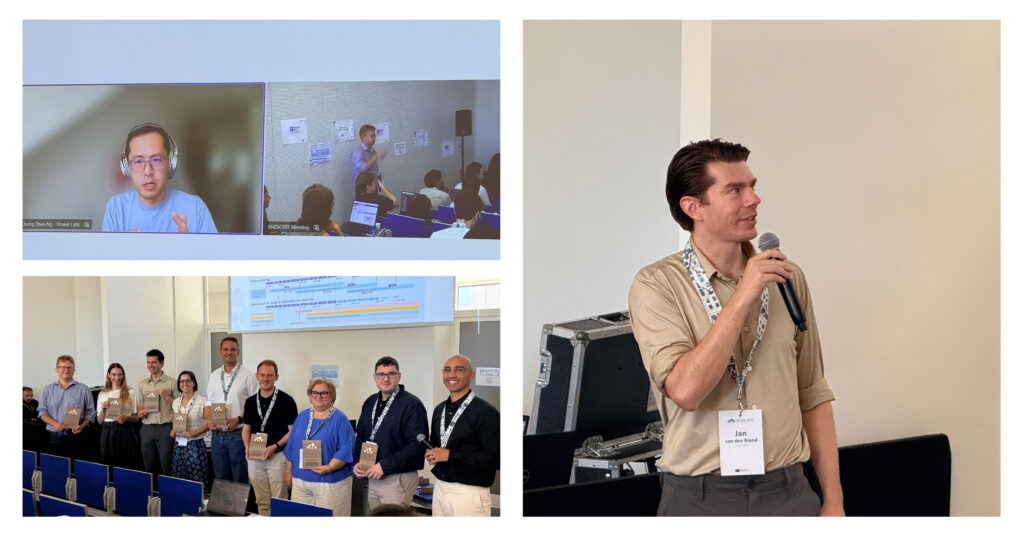
Jan van den Brand took us through the federated data platform, how it works and the roadmap towards training the very first federated machine learning model on INDICATE infrastructure. The principle sounds simple, but has major implications for how we can collaborate: Data stays. Insights travel.
Dr. Chong Shen Ng of Flower Labs introduced Flower and showed us how collaborative AI works in practice. From the difference between centralised and decentralised AI to the architecture behind federated learning, his live demo gave us a look under the hood of the technology enabling this new way of working.
Joost Huiskens from Microsoft Netherlands brought another important perspective: “Clinicians do not interact with models, they interact with solutions”. If we want AI to improve daily clinical practice, we need to think beyond developing good models. We need solutions that are robust, resilient, sustainable and able to fit into real clinical environments. Not only now, but also in the future. We need to think about achieving sovereignty together.
And that brings us to one of today’s second question: What does a hospital actually need to participate in INDICATE?
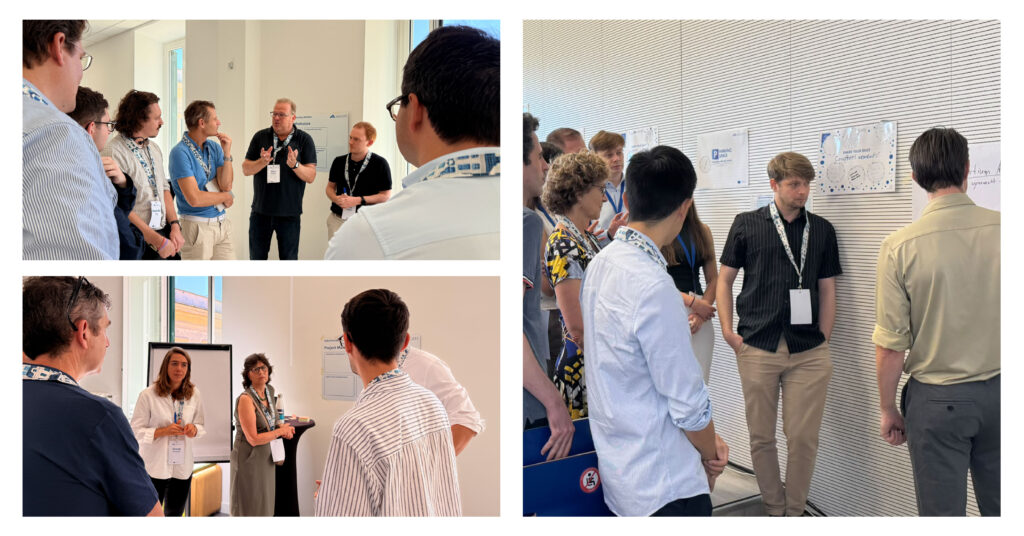
With Maarten Ligtenberg, Celia Alvarez Romero, Mark Driessen, Jan van den Brand and Bert Cappelle, we moved into a hands-on onboarding workshop. Participants worked through the steps required for both data providers and data users who will be using the tools, templates and guidance being developed within INDICATE. We collected experiences, identified obstacles and used feedback from our partners to make onboarding clearer and more scalable.
This afternoon, we went from onboarding an organisation to actually starting a research project on the INDICATE platform. Marcel Giemsa from University Hospital Düsseldorf guided us through the steps to onboard on the federated data platform of INDICATE.
First the organisation is onboarded, then its users can start creating and submitting research projects.The onboarding process was shared, tested and discussed with the consortium today. The feedback gathered will help us further improve the process before making the guidance available to future data providers and users.
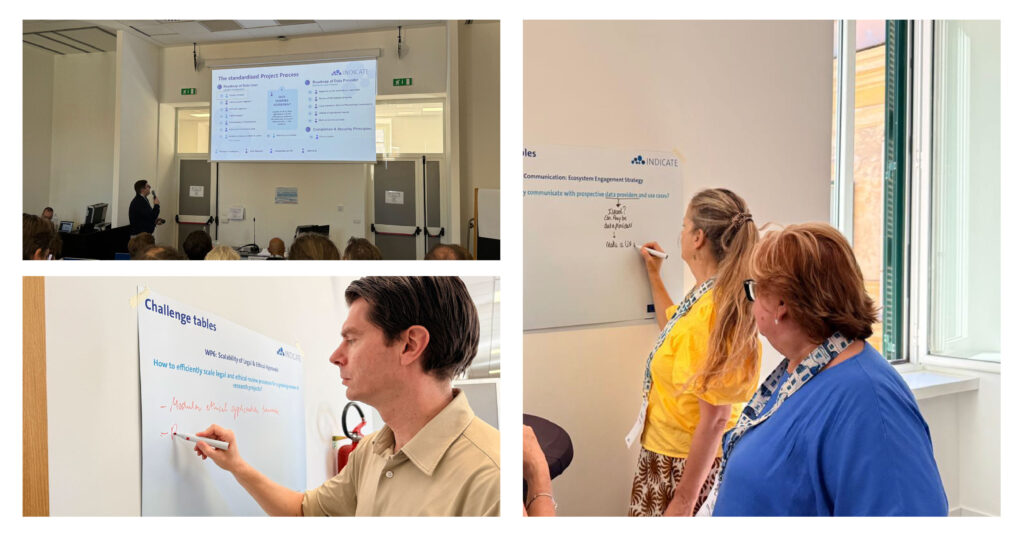
We then explored key practical challenges through interactive challenge tables, covering topics from data dictionary validation and sandbox requirements to scalable legal and ethical approvals, educational needs and communication ecosystem engagement.
Building a European federated infrastructure is not just about making the technology work. It is also about making it clear and practical for organisations and researchers to actually use it.
More insights from our consortium meeting tomorrow on Day 3!
Today we kicked off the INDICATE Consortium Meeting 2026 in Rome – Italy, hosted by Fondazione Policlinico Universitario Agostino Gemelli IRCCS.
We are halfway through the INDICATE project. Time to reflect on how far we have come and where we want to go next. From the soft launch in Brussels, to our first official consortium meeting in Seville in 2025, and now Rome, INDICATE has developed into a growing European community.
The main message of today was: “Data stays, insight travels.” Hospitals need to remain in control of their data. At the same time, better research and AI requires access to larger volumes of high-quality health data. INDICATE’s federated infrastructure is designed to bring those two needs together.
Prof. Dr. Dr. Christian Jung, INDICATE PI, reflected on the progress made during the first half of the project and shared some of the achievements so far.
Dr. Michel van Genderen highlighted that INDICATE is not just about building a product or a platform. It will work because we are building a community and we can only achieve our ambitions if we do it together.
Our work is part of a much bigger European ambition.
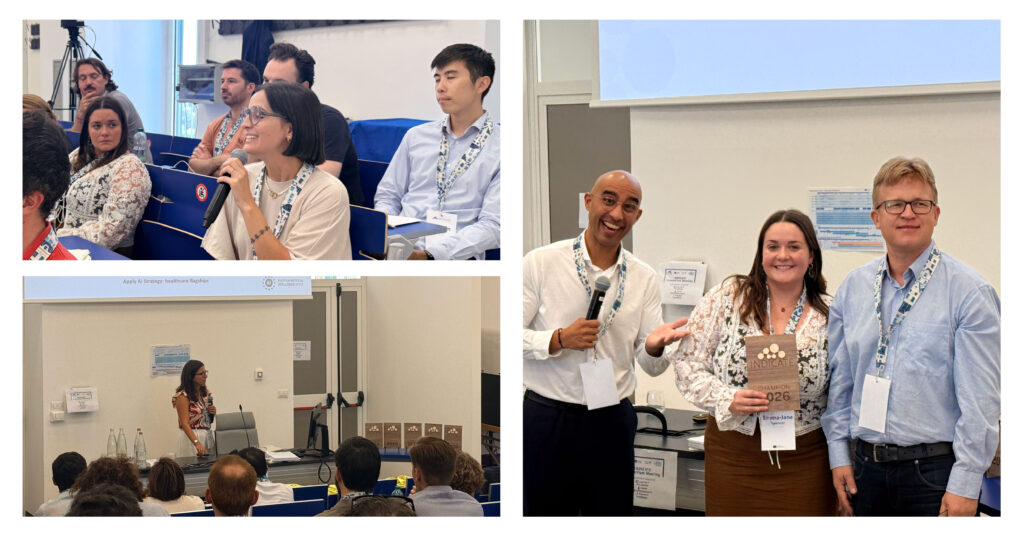
Our EU Project Officer Erica Martinelli shared the European perspective on AI, with a clear objective: “Make Europe the AI continent in the world!” It requires computing capacity, appropriate regulation, common European Data Spaces and AI skills for healthcare professionals, and combining innovation with trust.
We also received valuable perspectives from our external experts.
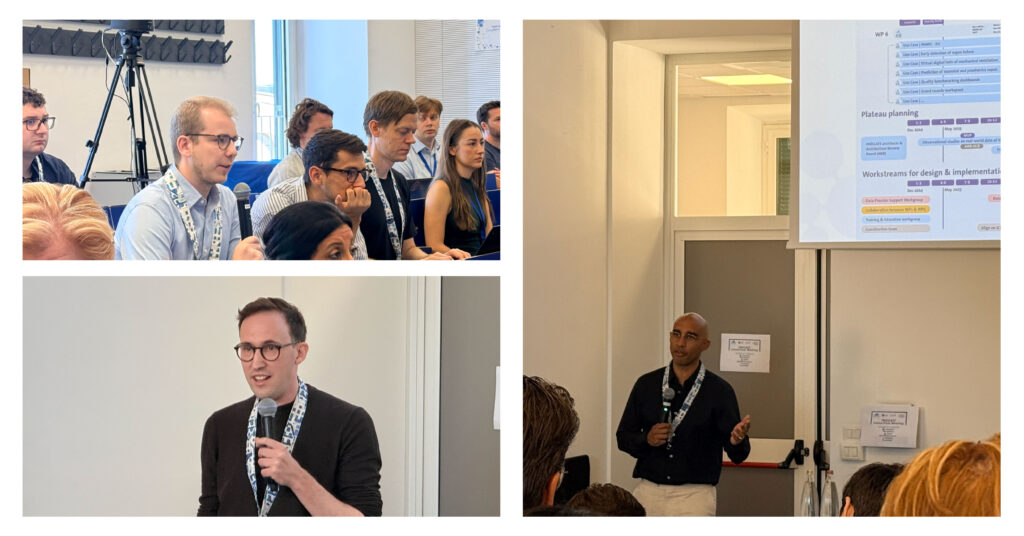
Emma-Jane Spencer, from our External Ethics Advisory Board, challenged us to keep ethics at the centre as the technology develops with continued attention to privacy, bias, explainability, data diversity, patient involvement and governance.
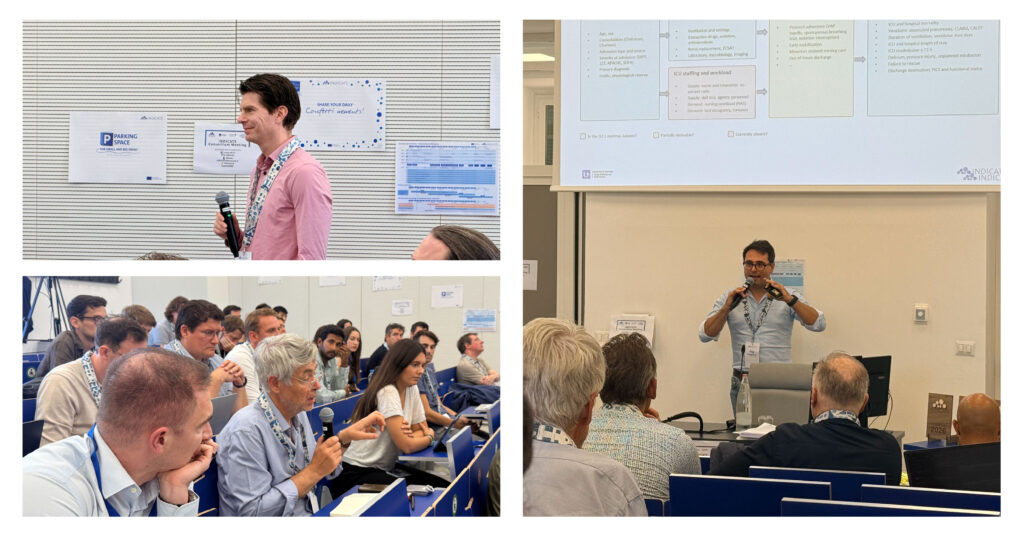
From Prof. Filip Haegdorens we heard that data on staffing and workload can provide crucial insights into quality of care and patient outcomes and should be added to the INDICATE data dictionary. Michael Beil challenged us to think about how AI will change clinical decision-making and workflows.
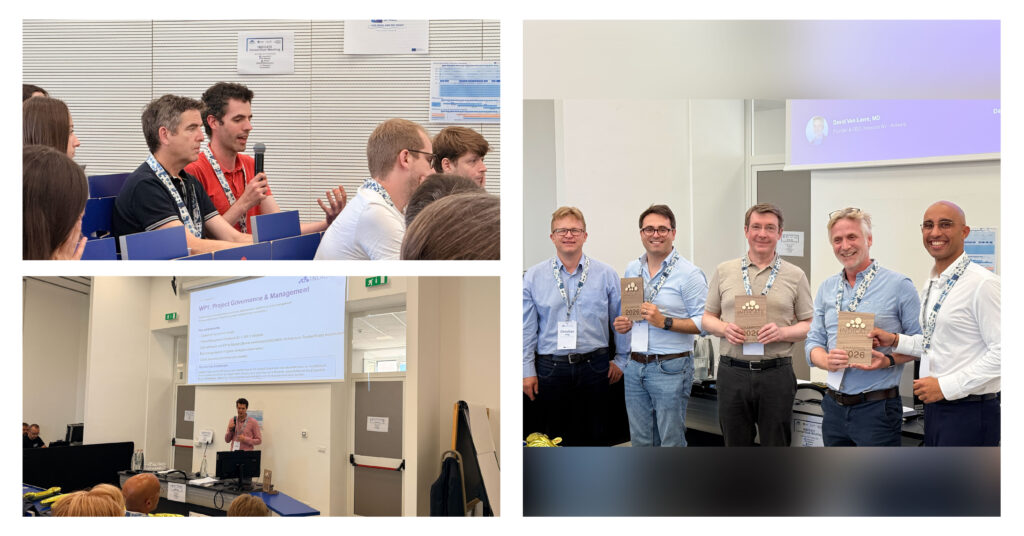
And David van Laere brought the discussion back to the bedside. Ultimately, AI models need to become tools clinicians can actually use. As he put it: “Hospitals, data infrastructures, and companies need to work together to create an ecosystem where risks, revenue and success are shared, because ultimately we all want the same: to save and improve patients’ lives.” That is a powerful reminder of where all this work needs to lead.
Finally, our Work Package Leads shared what has already been achieved across INDICATE from common data models to legal and ethical frameworks, sustainable governance, a user portal and technical infrastructure to run federated analyses, education and communication, and our clinical use cases as demonstrators.
Just as valuable were the lessons learned: pilot early and often, coordinate across work packages, support data providers, recognise dependencies and never underestimate the importance of data quality.
🎉 And after reflecting on two years of progress, there was also a moment to celebrate what we have achieved together, celebrating the confetti moments of the day! A fitting way to mark how far this community has come.
Tomorrow, we move from reflection to implementation: How can we make the infrastructure sustainable beyond the end of the project? Can it support other clinical areas beyond intensive care, such as cardiology and trauma? And how can we make it easier for new hospitals to join?
From data to insights. From infrastructure to clinical impact. On to Day 2!
The INDICATE Communication Network Meeting, organised by Work Package 5, took place on 9 September 2026.
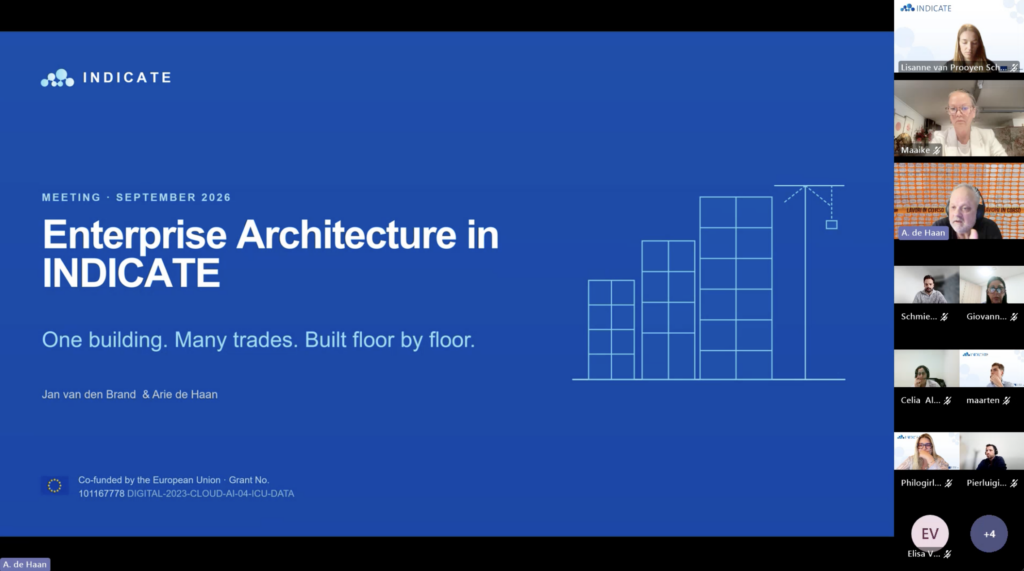
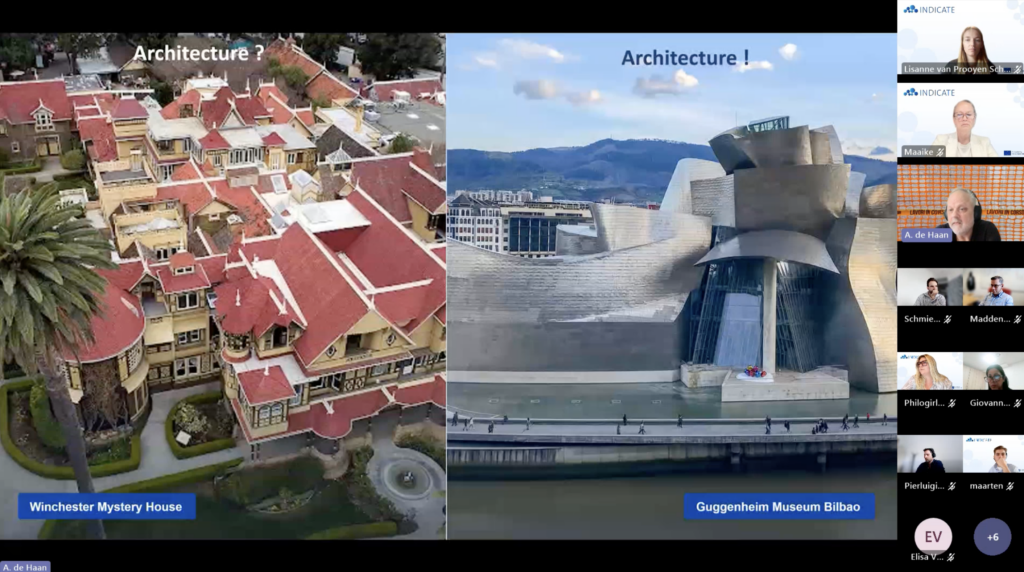
A key contribution to the meeting was a presentation by Arie de Haan (Principal Architect INDICATE) on building the INDICATE architecture. Arie presented an overview of the project’s enterprise architecture and explained how this provides the foundation for the development of the INDICATE ecosystem. Using the analogy of constructing a building, he illustrated how a shared architectural blueprint enables the different technical components developed across the work packages to come together as one coherent platform.
Maaike van Zuilen (INDICATE Communication advisor) presented an overview of the communication work carried out within INDICATE. Her presentation highlighted the communication activities undertaken throughout the project, the materials and resources developed, and the progress and achievements made so far. She also reflected on how these activities have supported the visibility of INDICATE, strengthened engagement with stakeholders and contributed to communicating the project’s objectives, developments and results to a wider audience.
The meeting further provided a valuable opportunity for participants to exchange experiences and share perspectives on communicating INDICATE within their respective organisations.
We’re happy to announce that the INDICATE Help Center is now live!
The help center is specifically set up for data providers who have technical questions related to the INDICATE portal. By submitting a ticket, they can easily reach the right support and receive focused and efficient assistance with the technical questions.
You can access the help center directly via here or the button on the INDICATE website.