News

Publiced on:
The second training of the INDICATE Training Programme on Interoperability, OMOP and Vocabularies took place on April 9, 2026. The programme is designed to support data providers in using the INDICATE infrastructure effectively, securely, and in a fully standardised way. It helps participants, such as clinicians and data engineers, build both the conceptual understanding and practical skills needed to work with interoperable health data.
During this second training, led by Maxim Moinat (Researcher, Medical Informatics, Erasmus MC) and moderated by Boris Delange (MD, Medical Informatics, Université de Rennes), participants learned that data from different hospitals and institutions must be made interoperable to enable research at a European level. However, this is only possible when data is structured in a way that makes comparison meaningful and reliable.
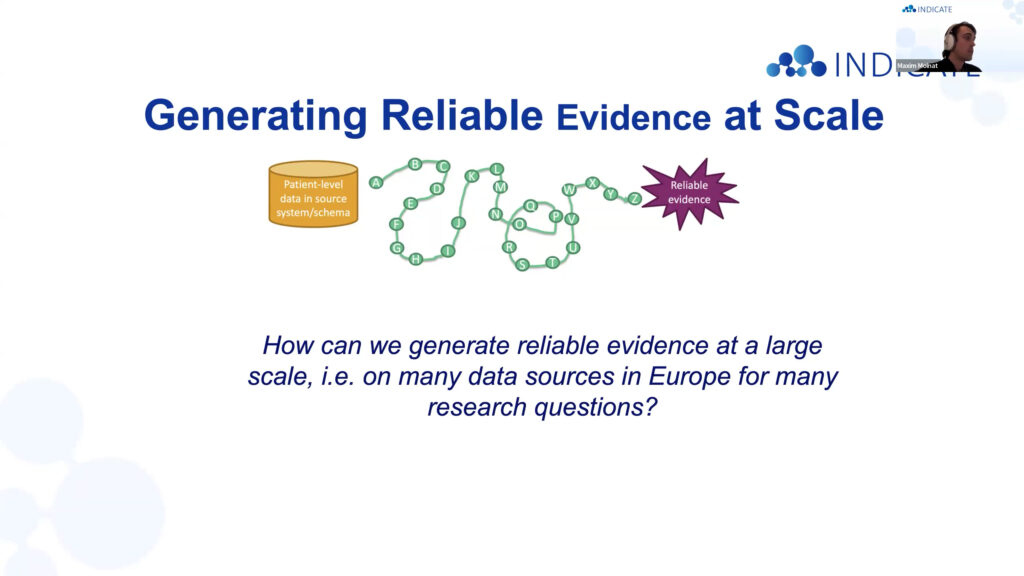
This is where standardisation becomes essential. Without a shared structure, data remains fragmented across systems, making large-scale analysis difficult or even impossible. By harmonising data into a common format, researchers can generate evidence that is consistent, reproducible, and scalable across countries.
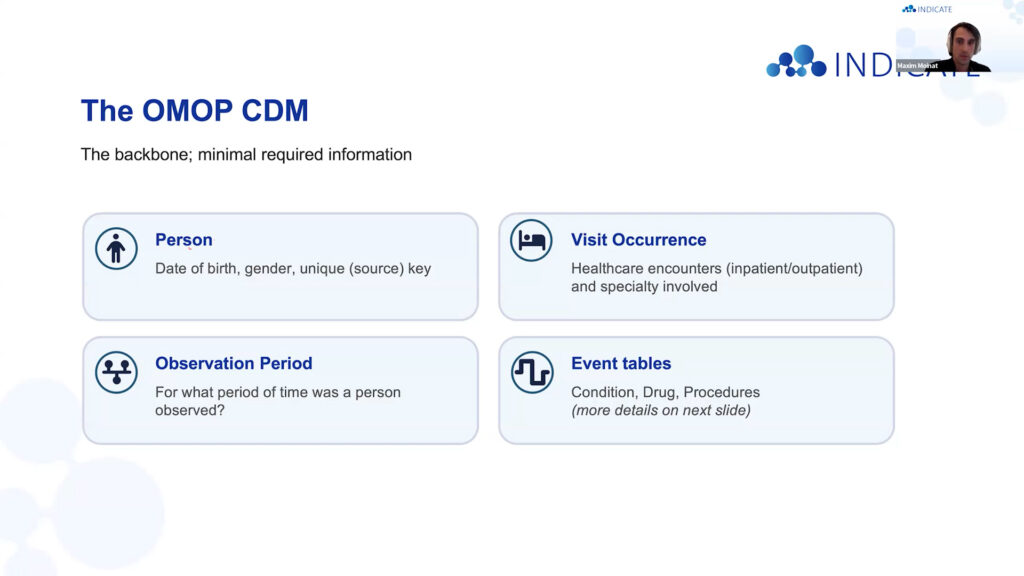
The OMOP Common Data Model provides exactly this; a shared way of organising patient data and a shared vocabulary for describing clinical events, so that hospitals across Europe can describe the same reality in the same terms. Maxim walked participants through the main building blocks of the model and showed how they apply to ICU data, with concrete examples detailed during the session. He also presented the wider OHDSI community and European networks such as EHDEN and DARWIN EU, which already federate data on hundreds of millions of patients.
Maxim then walked participants through the full journey from raw hospital data to interoperable, OMOP-formatted data, step by step, from the initial exploration of the source system to the final validation of the mapped database. At each stage, he introduced the corresponding tools from the OHDSI ecosystem, a suite of open-source resources designed to support data providers throughout the process. He also showed how the INDICATE Data Dictionary, presented in Session 1, fits into this journey by guiding data providers on which clinical concepts to prioritise for mapping.
The session concluded with key take-home messages on the importance of clear mapping specifications, vocabulary alignment, and the value of a shared data model for enabling collaborative research across institutions and countries.
Overall, the training provided participants with both a conceptual and practical understanding of how the OMOP CDM and the surrounding OHDSI ecosystem support interoperable and scalable health data research within INDICATE.
The next training will focus on the ETL Workflow, data preparation requirements, and data quality expectations and is planned on May 7 2026.
More news


