News

Publiced on:
This week marked the first session of the INDICATE Training Programme, designed to support data providers in using the INDICATE infrastructure effectively, securely, and in a fully standardized way.
The session, guided by moderator Maxim Moinat (Data Engineer, Erasmus MC) and co-moderated by Maarten Ligtenberg (Co-founder Cradeq), provided a solid introduction to key building blocks on the INDICATE onboarding framework, interoperability in complex healthcare data environments and federated data infrastructure and secure data sharing principles.
Jan van den Brand (technical lead INDICATE) highlighted key challenges in ICU clinical decision-making and innovation, driven by fragmented data, a lack of standardized data-sharing agreements, and limited secure infrastructure. He illustrated this using a metaphor: hospitals today resemble a house with different types of power sockets, where every device requires its own adapter to function.
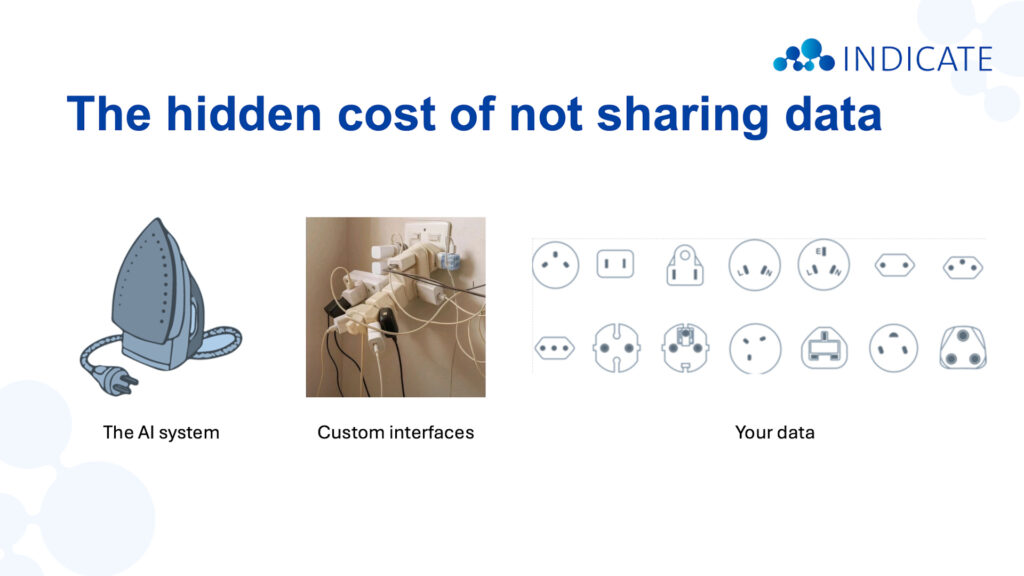
In this analogy, medical and AI software represent the appliances, while hospital systems such as electronic health records and laboratory databases represent the power sources. Without a shared standard, hospitals are often forced to build and maintain these “adapters” themselves, increasing complexity, cost, and operational risk. This underlines the need for shared standards and interoperable data models.
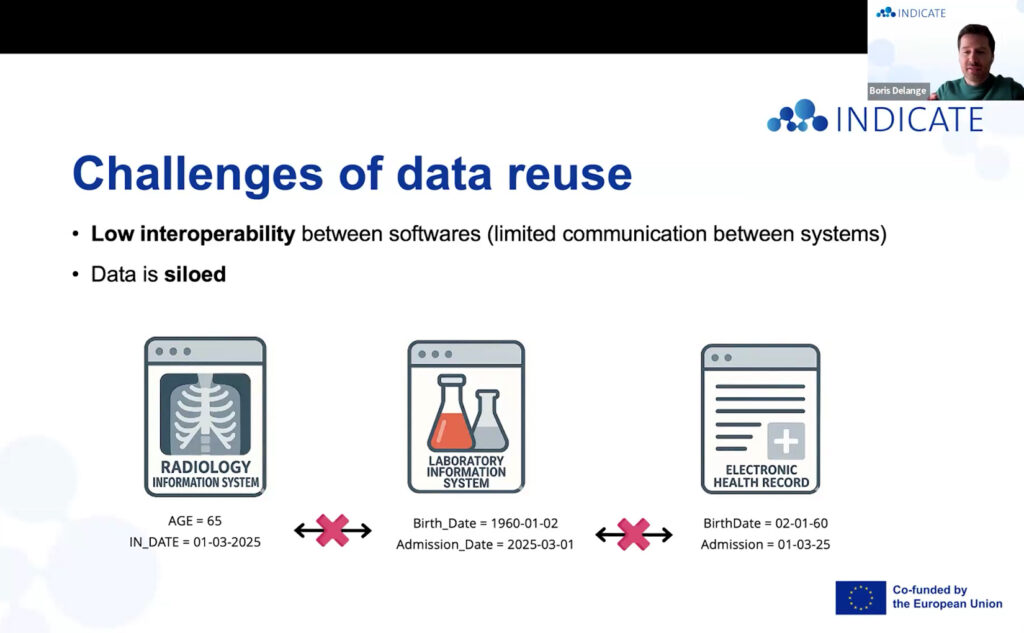
A central theme, introduced by our presenter Boris Delange (Doctor in Medical Informatics, Université de Rennes), was the reality of hospital data: each institution often uses its own “language” to describe the same clinical concepts. This creates significant challenges for interoperability and data integration, while also highlighting the importance of standardization for enabling meaningful reuse of healthcare data in research and innovation.
Boris also addressed the broader context of Hospital Information Systems and Clinical Data Warehouses, focusing on challenges related to data quality, semantic alignment, and making heterogeneous data usable beyond clinical care. Despite its value, a large proportion of hospital data (97%!) remains underutilized for research purposes.
INDICATE addresses this challenge by developing a federated data infrastructure, where data remains securely stored within its original institution (the data never leaves the hospital) while becoming interoperable and accessible for analysis across organisations through shared standards.
The training programme consists of five sessions. The next session will take place on April 9, 14:00–16:00 CEST.
The training sessions are organised by Maarten Ligtenberg, Melania Istrate, Elisa Vera, Jan van den Brand, Aliza Bos, Maaike van Zuilen, and Irene Gebuis, a collaboration between Work Packages 1 and 5 and the INDICATE Training and Education Workgroup.
More news


